You get home after a couple of hours on the road, and your neck won’t cooperate. It’s not a headache, nor is it the helmet pressing against your forehead or temples—we’ve already covered in this article, and that’s a different problem. This is something else: stiffness in the back of your neck, tension that radiates down to your trapezius muscles and shoulders, and a feeling of muscle fatigue that sometimes lasts until the next day.
It’s not a coincidence or just “part of getting older.” Neck pain from riding a motorcycle has specific physical causes—weight, wind, and posture—and in most cases, it can be prevented without having to stop riding. Let’s look at them one by one.
Why Does Your Neck Hurt After Riding a Motorcycle for a While?
A motorcyclist’s neck is forced to work in a way for which it is not particularly suited: it supports an added load (the helmet) in a semi-fixed position while being exposed to direct airflow. Four factors come into play:
- The weight of the helmet. It’s not just the weight itself, but the fact that this weight is shifted away from the body and acts as a lever every time you turn your head to look in a rearview mirror or at an intersection. A 1,700-gram helmet moving to check your blind spot requires much more muscular effort than your head alone, without a helmet.
- Wind resistance. At speeds of around 90–100 km/h, the air constantly pushes against your helmet. Your neck muscles have to contract continuously—what’s called an isometric contraction—just to keep your head in place. It’s the same kind of effort that tires your arm if you hold it outstretched for a long time, but applied to your neck.
- The driving position. The further forward your arms are in relation to your body (sporting position) or the more you tilt your head forward to see the road, the more strain is placed on the lower cervical region and the trapezius muscles.
- Lack of rest and muscle tone. An untrained neck tires more quickly. Long stretches of continuous activity build up tension that doesn’t have time to dissipate.
The good news: all four factors can be addressed. Let’s start with the one that’s most often underestimated.
Helmet weight: the most underestimated factor
A helmet doesn’t just weigh what the scale shows: as the volume and diameter of the head increase, so does the lever arm. This means that a helmet that’s 200 g heavier doesn’t feel 10% heavier on your neck—it feels significantly heavier, because that extra weight is farther from the axis of your neck than the weight of your own head.
That’s why, if you’re riding long distances or navigating city streets with lots of stops and sharp turns, the weight of your helmet matters more than it might seem at first glance. Within the ADN line, the ADN Spritz is the lightest, weighing 1,000 g in its smallest size—designed specifically to minimize that burden during urban use. The ADN Cosmo weighs in at 1,300 g, and the ADN Mojito weighs 1,350 g. If your priority is to reduce neck strain on short, urban rides, a lightweight jet helmet is, all things being equal, less taxing on the neck than a full-face helmet with more features (and more weight).
This doesn’t mean that a full-face helmet is a bad idea—it offers protection on roads and highways that a jet helmet doesn’t—but you should be aware that more features (sun visor, Pinlock, adjustable ventilation) almost always mean more weight, and your neck bears the brunt of that weight.
Aerodynamics: On the highway, turbulence matters more than grams
At highway speeds, the shape of the helmet matters even more than its weight. A helmet with poor aerodynamics creates turbulence and a “pull” effect—either backward or to the sides—that forces the neck to constantly adjust the position of the head. This is why many motorcyclists experience more neck pain on the highway than in the city, even though they turn their heads much more often in the city.
Two design details have a direct impact:
- The rear wing. A full-body design with an aerodynamic spoiler, like the ADN Stelvio, is designed to stabilize airflow at high speeds and reduce that “pull.” It’s one of the reasons why, on long stretches of highway, a well-designed full-face helmet is often more comfortable for the neck than an open-face helmet, even though it weighs more.
- The visor on adventure helmets. A removable visor like the one on the ADN Duale protects against the sun and branches off-road, but at sustained highway speeds it can create more drag and put more strain on the neck than a helmet without a visor. That’s why well-designed adventure helmets let you remove it: on roads and trails, with the visor; on the highway and long trips, without it. We’ve already we’ve explained here when each configuration makes sense.
If you ride many kilometers on the highway, adjusting your helmet’s aerodynamics—and removing the visor when you don’t need it—can make a bigger difference to your neck than switching to a different model.
Your posture while driving also plays a role
The helmet doesn’t work on its own—it works in conjunction with your posture on the motorcycle. If the handlebars are too low or too far forward, your head tends to lean forward to keep your eyes on the road—the same “text neck” effect caused by cell phones, but compounded by the weight of the helmet and the wind. Here are some simple adjustments:
- Make sure that the mirrors and handlebars allow you to keep your head in a neutral position, without having to tilt it forward to see clearly.
- Look through the center of the screen—not over it or by tilting your chin toward your chest.
- If you ride a naked or touring motorcycle, check the handlebar height if you notice that your arms are stretched too far forward: this shifts weight and tension directly to your neck and trapezius muscles.
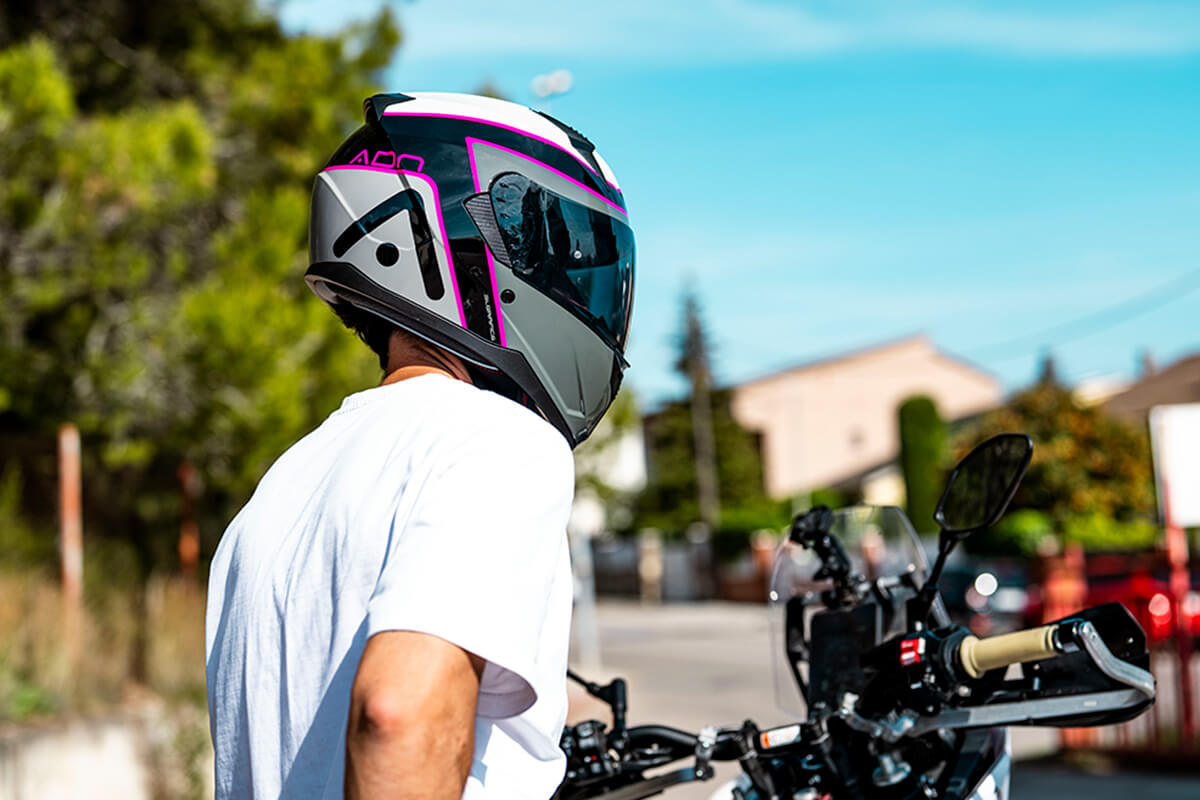
Which Type of Helmet Puts the Most Strain on the Neck (Comparison)
| Hull Type | Relative weight | Aerodynamic performance | Best fit for the neck |
|---|---|---|---|
| Jet (Spritz, Cosmo, Mojito) | Low (1,000–1,350 g) | No nose or chin rest; minimal turbulence at low speeds | City driving, short trips, frequent stops |
| Integral (Stelvio, Veloce) | Medium | Optimized aerodynamics with spoiler; stable at high speeds | Highway and open road, long distances |
| Modular (Audace) | Medium | Similar to a full-face helmet with the chin guard closed | Touring with frequent stops |
| Adventure (Duale, Duale Dakar) | Medium | The nose cone adds drag at high speeds if not removed | Mixed routes; remove the nose cone on the highway |
How to Relieve and Prevent Neck Pain After Riding
You don’t have to stop wearing the helmet you like or buy a new one to see an improvement. These are the steps that make the biggest difference:
- Take breaks every 90–120 km on long rides. Get out of the car, walk for a couple of minutes, and gently rotate your neck in circles. Sustained isometric tension is the main cause of neck fatigue, and breaking it up every so often prevents it from building up.
- Stretch before and after your run. Gentle neck rotations, side bends while lightly supporting your head with your opposite hand, and shoulder shrugs (up and down) for 20–30 seconds each.
- Work on your neck muscles when you’re off the bike. Simple isometric exercises—pressing your forehead against the palm of your hand without moving your head, and doing the same on the sides and at the back of your neck, holding each position for 5–10 seconds—strengthen your neck without needing to go to the gym.
- Make sure your helmet fits properly. A helmet that’s too loose forces the neck to compensate for the helmet’s extra movement on the head; one that’s too tight creates pressure points that put strain on the entire area. Check out our size guide to rule out the possibility that the fit is part of the problem.
- Choose a helmet that’s right for the type of ride. As we’ve seen, a lightweight helmet for city riding and an aerodynamic full-face helmet for highway riding distribute the load more effectively than always using the same helmet for everything.
- Increase your mileage gradually. If you haven’t been running long distances for months, your neck needs to adapt just like any other muscle group. Start with shorter runs and gradually increase the distance.
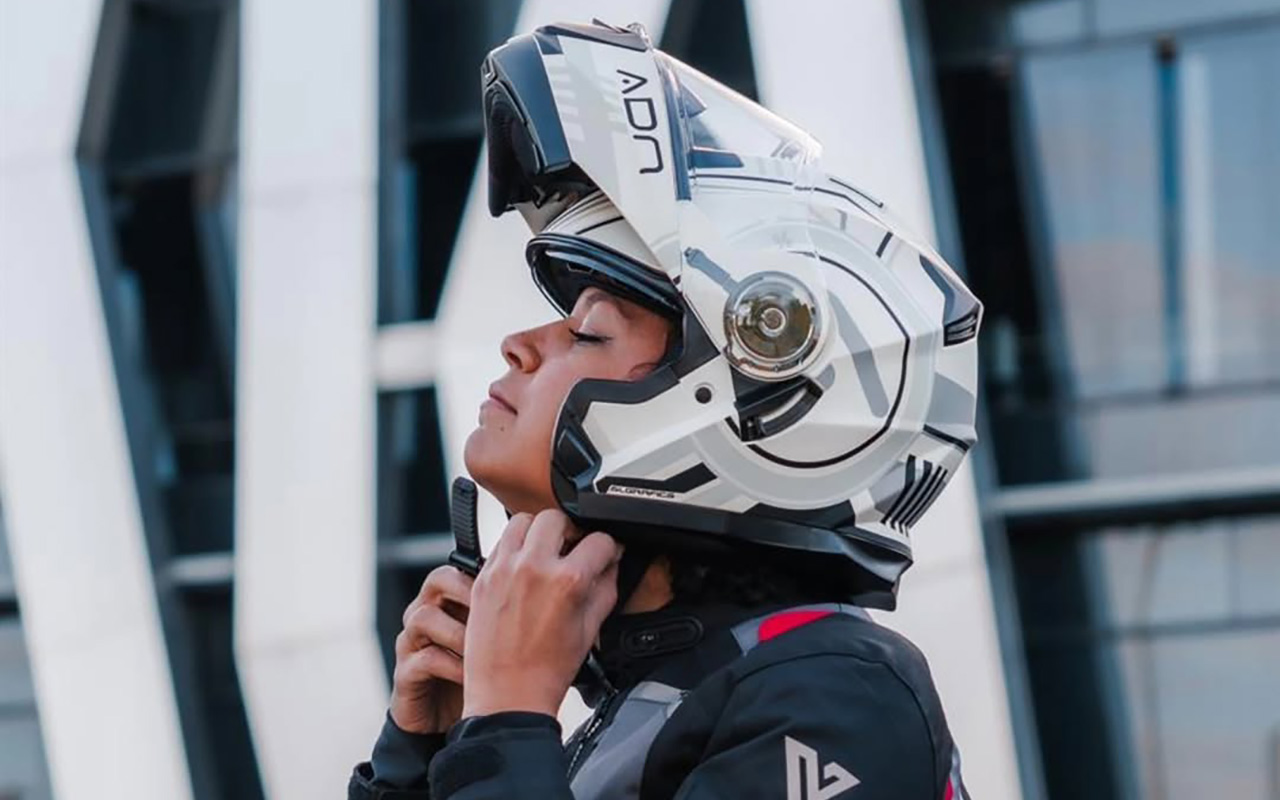
When Neck Pain Isn’t Just Due to the Helmet
Most neck discomfort experienced by motorcyclists is muscular in nature and can be resolved with the measures described above within a few days. However, there are certain symptoms that should not simply be attributed to the helmet or the motorcycle, and for which it is advisable to consult a physical therapist or a doctor:
- Tingling, numbness, or loss of strength in the arms or hands.
- Pain that radiates from the neck into the arm, not just toward the shoulder.
- Pain that does not improve after several days of rest, or that gets worse over time.
- Dizziness, severe headache, or marked stiffness when moving the neck in any direction.
This is general information and is not a substitute for a professional evaluation: if you notice any of these signs, consult a physical therapist or doctor before continuing to run long distances.
Frequently Asked Questions About Neck Pain When Wearing a Motorcycle Helmet
Does the weight of the helmet have such a big impact on neck pain?
Yes, and more than you might think. The weight of the helmet acts on a longer lever arm than that of the head without a helmet, so differences of 200–300 g are noticeably significant on long rides or those involving a lot of head movement. For urban use, a lightweight open-face helmet like the ADN Spritz (1,000 g) reduces that burden compared to more fully equipped and heavier models.
Is neck pain the same as a helmet that’s too tight and causes a headache?
No. A pressure headache is usually caused by a helmet that’s the wrong size or shape, which creates localized pressure points on the forehead or temples—we cover this in detail in this article. Neck pain is muscle fatigue in the neck and trapezius muscles caused by weight, wind, and posture, and it can occur even with a helmet that fits perfectly.
What kind of helmet is best for preventing neck pain on the highway?
On the highway, a full-face helmet with good aerodynamics and a rear spoiler—such as the ADN Stelvio—typically generates less turbulence and less drag on the neck than an open-face helmet or an adventure helmet with the visor up. If you’re wearing an adventure helmet, removing the detachable visor on highway stretches significantly reduces that drag.
How many breaks should I take on a long motorcycle trip to avoid neck pain?
As a general guideline, taking a short break every 90–120 km helps relieve sustained isometric tension in the neck before it builds up. Use the break to walk around a bit and move your neck with gentle rotations.
Do neck exercises help prevent neck pain from riding a motorcycle?
Yes. Simple isometric exercises (pressing your forehead, the back of your neck, and the sides of your head against your hand without moving your neck, holding the position for a few seconds) strengthen the neck muscles and reduce fatigue during long trips. They are not a substitute for an evaluation by a physical therapist if the pain is persistent or severe.
When should I see a doctor for neck pain related to riding a motorcycle?
If the pain does not improve after several days of rest, radiates into the arm, or is accompanied by tingling, numbness, or loss of strength in the hands or arms, you should see a physical therapist or a doctor. These symptoms may indicate something other than the typical muscle fatigue experienced by motorcyclists.