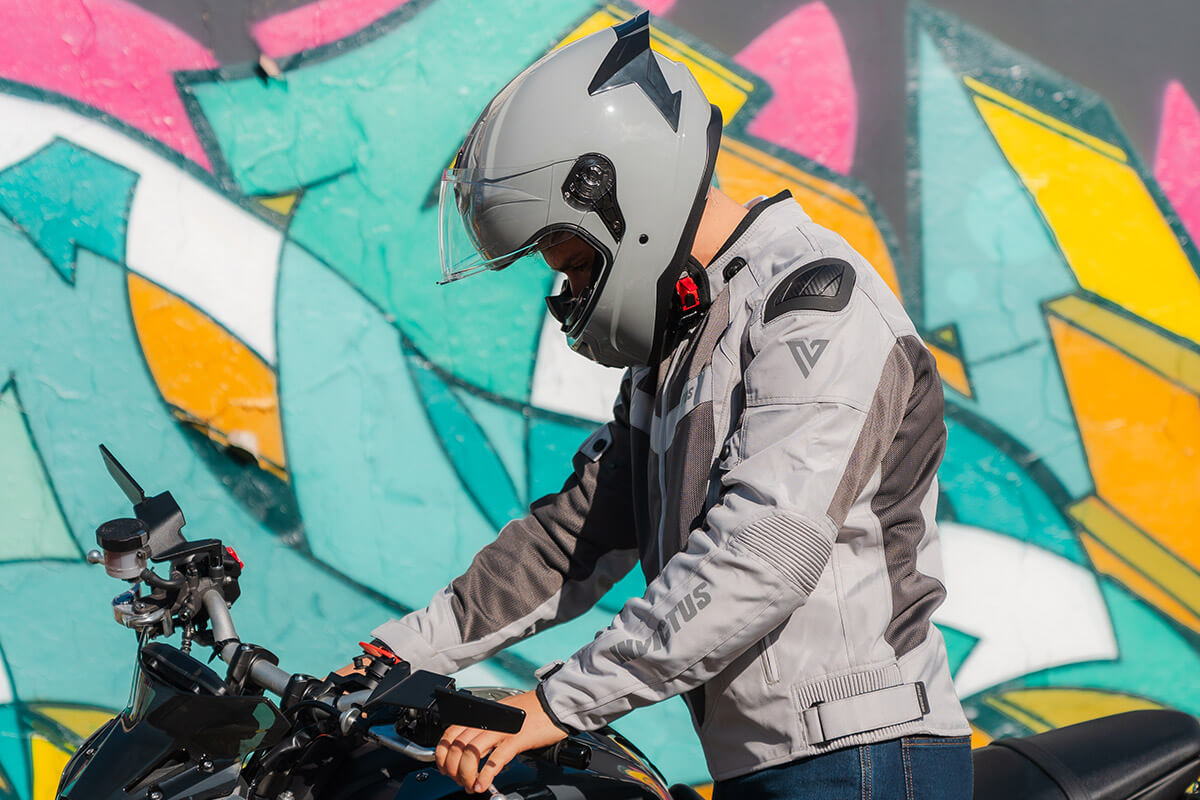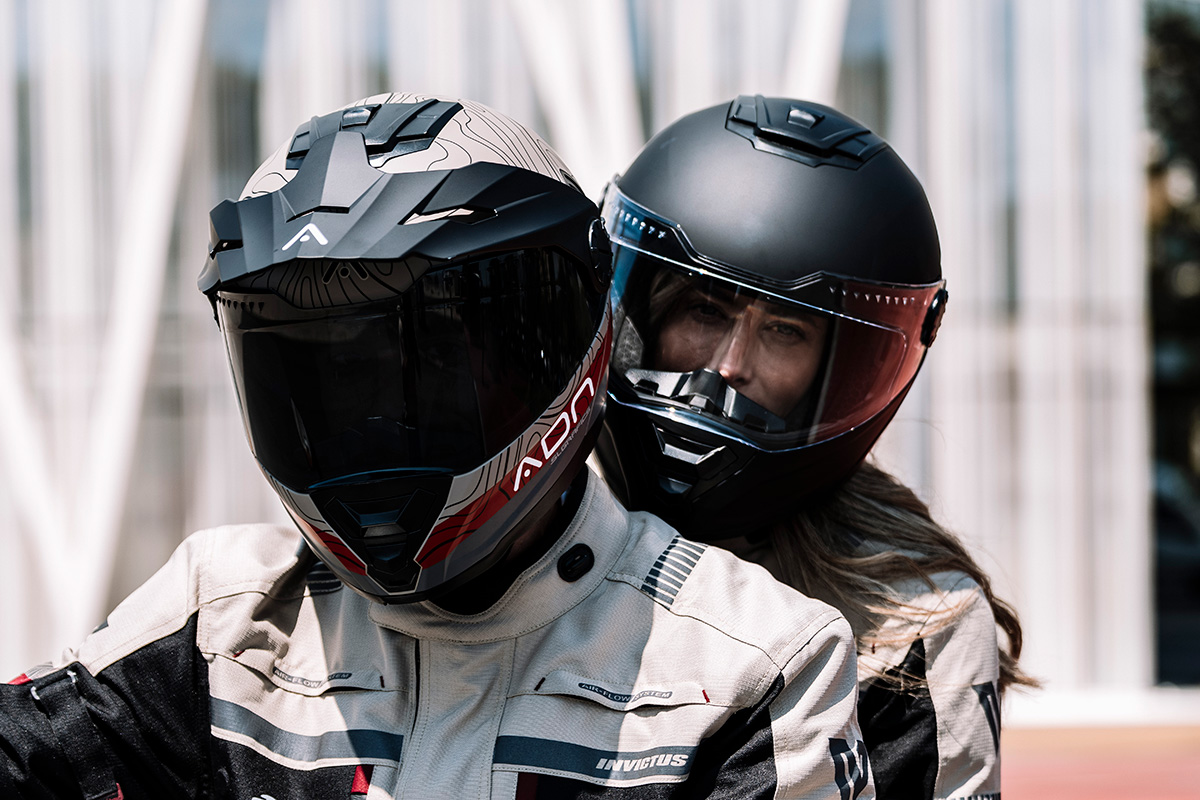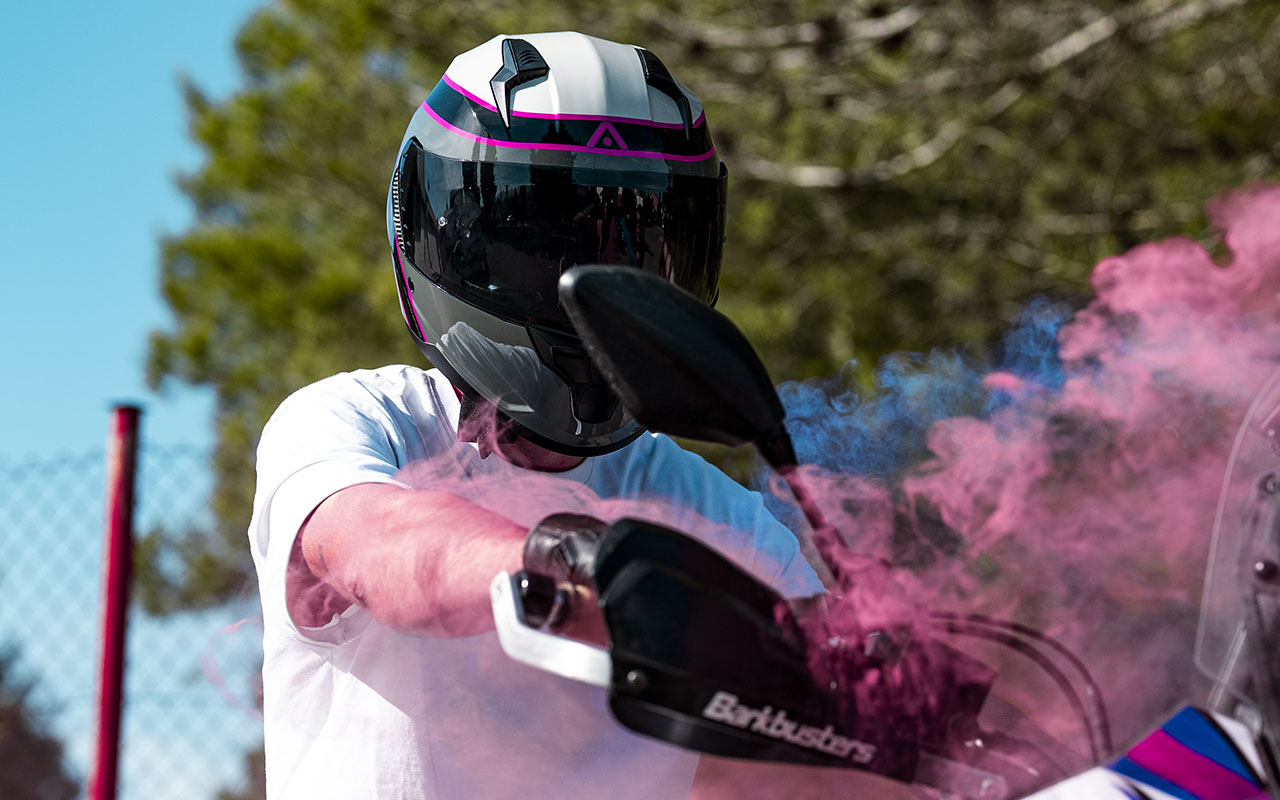
If you’ve been searching for a helmet for your trail or adventure bike, you’ve probably come across both terms used almost interchangeably. And you may have wondered: is there a real difference between an adventure helmet and a trail helmet, or are they exactly the same thing? In this article we clear it up once and for all.
Are adventure and trail helmets the same thing?
In the market, yes — in practice they are used as synonyms. Manufacturers, retailers and riders use “trail helmet”, “adventure helmet” and “adventure trail helmet” interchangeably to refer to the same type of helmet: one designed for mixed use on tarmac and dirt, with a removable peak, a wide field of vision and compatibility with off-road goggles.
There is no regulation or homologation category that distinguishes between an “adventure helmet” and a “trail helmet”. All are approved under the same standard — ECE 22.06 in Europe — regardless of what the manufacturer calls them.
That said, there is an informal usage distinction that some riders make:
- Trail helmet — a term more associated with off-road use and trial, enduro and light trail bikes. It typically implies greater ventilation, better compatibility with off-road goggles and a more sporting profile.
- Adventure helmet — a broader term, associated with maxi-trail and adventure touring bikes. It prioritises comfort on long-distance roads, aerodynamics and features such as a sun visor or Pinlock.
Even so: in the market these differences are a matter of nuance, not category. The same helmet appears listed as “trail” in one shop and “adventure” in another.
What features define an adventure trail helmet
Whatever you call it, a good adventure trail helmet always shares these characteristics:
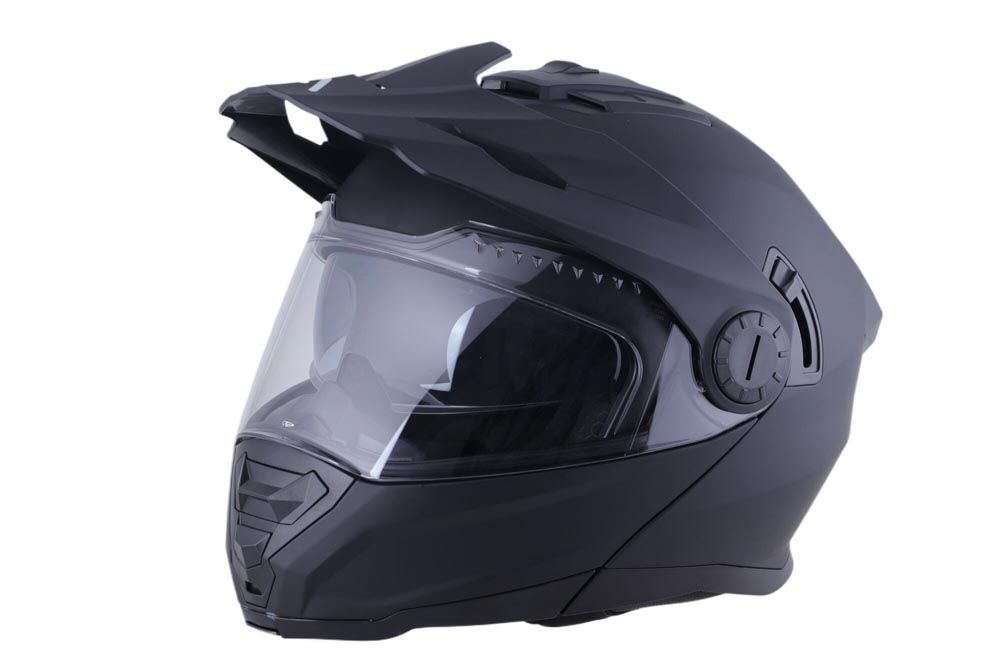
Removable peak. This is the most visually distinctive feature of this type of helmet. It protects against sun, mud and branches when riding off-road. On tarmac it can generate slightly more aerodynamic drag — which is why most models allow it to be removed for touring use.
Wide field of vision. The visor is usually more panoramic than on a standard full-face helmet, improving visibility on uneven terrain where obstacles need to be anticipated quickly.
Off-road goggle compatibility. Well-designed trail helmets have an enlarged visor aperture to allow the use of motocross goggles. Not all adventure helmets offer this — an important detail if you do genuine off-road riding.
Generous ventilation. More air intakes than a road full-face helmet, designed for low-speed riding on trails where natural airflow is limited.
Removable and washable interior. Essential in a helmet that will encounter dust, mud and sweat. The best models include a hypoallergenic and breathable interior.
Which type of rider needs an adventure trail helmet
This type of helmet is the right choice if:
- You ride a trail, adventure or maxi-trail bike and use it on mixed routes — part tarmac, part dirt track.
- You go on weekend getaways that combine road and country lanes.
- You travel by motorcycle and want a single helmet that works for the entire journey.
- You’re interested in the Dakar world or rally bikes and want that functional aesthetic.
It is not the right choice if you exclusively ride technical enduro or motocross — for that you need a specific cross helmet without a visor. Nor if your riding is entirely on road and in the city — for that, a standard full-face or modular helmet will be lighter and more aerodynamic.
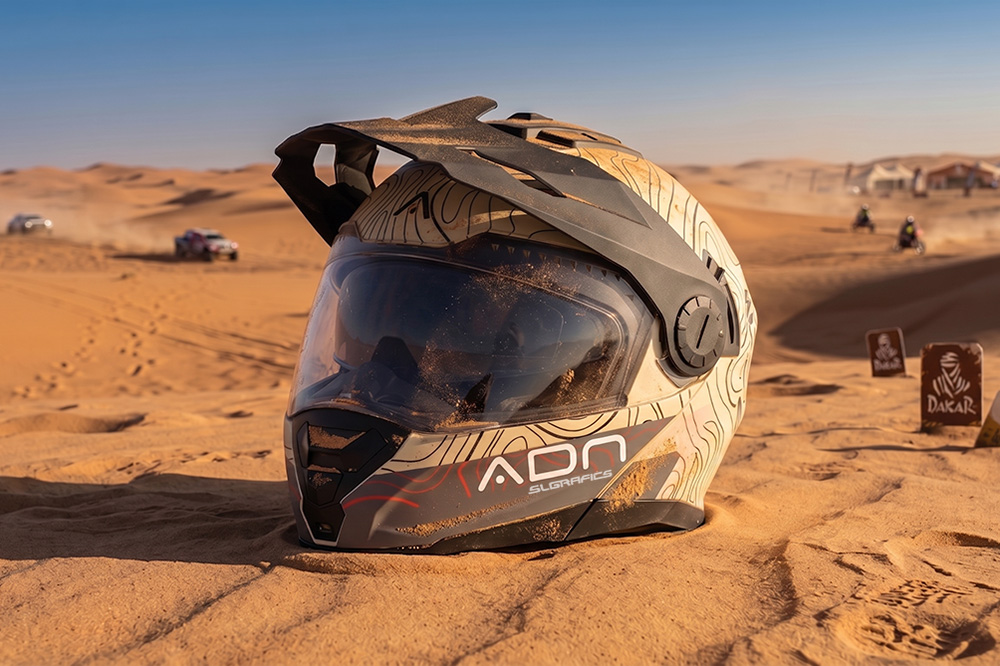
The ADN Duale: a helmet for both worlds
In the ADN range, the model that answers this question directly is the ADN Duale — the only helmet in the range with an adventure trail design and dual ECE 22.06 P/J homologation.
P/J means you can legally ride with the chin guard either closed or open — something not all modular helmets allow. The peak is fully removable: wear it on tracks and trails and take it off in seconds when you return to the tarmac. It includes an integrated sun visor, a visor prepared for Pinlock 70, a removable hypoallergenic interior, removable nose guard and chin curtain, and Bluetooth intercom compatibility.
It weighs 1,700 grams in size M — a reasonable weight for an adventure modular with all these features. Available in sizes XS to XXL, in solid colours (Black Matt and Nardo) and special graphic versions.
ADN Duale Dakar: the same helmet, with the spirit of the rally
If you’re looking for functionality and a design with real character, the ADN Duale Dakar is the special edition of the Duale inspired by the most demanding rally in the world. Same technical specifications — ECE 22.06 P/J, removable peak, sun visor, Pinlock 70 — with four exclusive limited-edition graphics: Atacama Chalk, Moon Grey, Mojave Desert Stone and Sahara Sand.
For those who see motorcycling as an adventure, the Duale Dakar is not just a helmet — it’s a statement of intent.
Want to explore the full ADN adventure range? Visit the ADN adventure helmets.
Frequently asked questions about adventure and trail helmets
Is a trail helmet the same as an adventure helmet?
In the market they are used as synonyms. There is no homologation category that distinguishes between them — both are certified under ECE 22.06. The difference is purely one of brand positioning: “trail” tends to be associated with more off-road use and “adventure” with more touring use. Many manufacturers use both terms for the same model.
Can I use an adventure trail helmet on the road?
Yes. An adventure trail helmet with ECE 22.06 homologation is perfectly valid for riding on roads and motorways. The peak may add slightly more aerodynamic drag at high speed, but most models allow it to be removed for exclusively tarmac use.
What is the difference between an adventure trail helmet and an enduro helmet?
An enduro or motocross helmet has no visor, no polycarbonate screen and no homologation for use on public roads. An adventure trail helmet has a visor, is road-approved and combines tarmac and light off-road use. For technical enduro or motocross, you need a specific cross helmet.
Is the ADN Duale suitable for off-road riding?
The ADN Duale is designed for light off-road use: forest tracks, country lanes and non-technical trails. Its removable peak offers protection on the terrain and its breathable interior manages heat effectively. For technical enduro or motocross at high speed, you need a cross helmet without a visor approved specifically for that purpose.
What does P/J homologation mean on a modular adventure helmet?
P/J homologation certifies that the helmet is safe both with the chin guard closed (P, for Protective) and with the chin guard open (J, for Jet). A modular with only P homologation cannot legally be ridden with the chin guard open while moving. The ADN Duale and ADN Duale Dakar have P/J homologation — you can ride with the chin guard open or closed without restriction.